
Studying law in the United Kingdom is a pursuit of understanding one of the oldest and most influential legal frameworks in existence. For the aspiring solicitor or barrister, the journey is defined by a rigorous engagement with a system that is both steeped in tradition and constantly evolving. Unlike jurisdictions with a single codified constitution, the UK relies on a patchwork of statutes, judicial precedents, and conventions. This fluidity presents a unique challenge: the law is not just something to be read, but something to be interpreted through the lens of history and social context.
The academic intensity of a qualifying law degree in the UK cannot be overstated. Students are expected to master complex modules such as Equity and Trusts, Public Law, and Land Law within strict timeframes. In this high-pressure environment, maintaining a competitive edge often requires more than just independent study. Many successful scholars utilise professional coursework help UK to refine their analytical frameworks and ensure their arguments are supported by the most current judicial rulings. This balanced approach to learning allows students to bridge the gap between abstract legal theory and its practical application in university assessments.
Furthermore, the demand for precision in legal writing—specifically the requirement to adhere to the Oxford Standard for Citation of Legal Authorities (OSCOLA)—means that even the most brilliant legal minds can stumble on technicalities. To mitigate these risks and secure first-class honours, students frequently turn to a reputable law assignment writing service. Such services provide the necessary scaffolding for students to structure their IRAC (Issue, Rule, Application, Conclusion) responses effectively, ensuring that every submission meets the exacting standards of British legal academia.
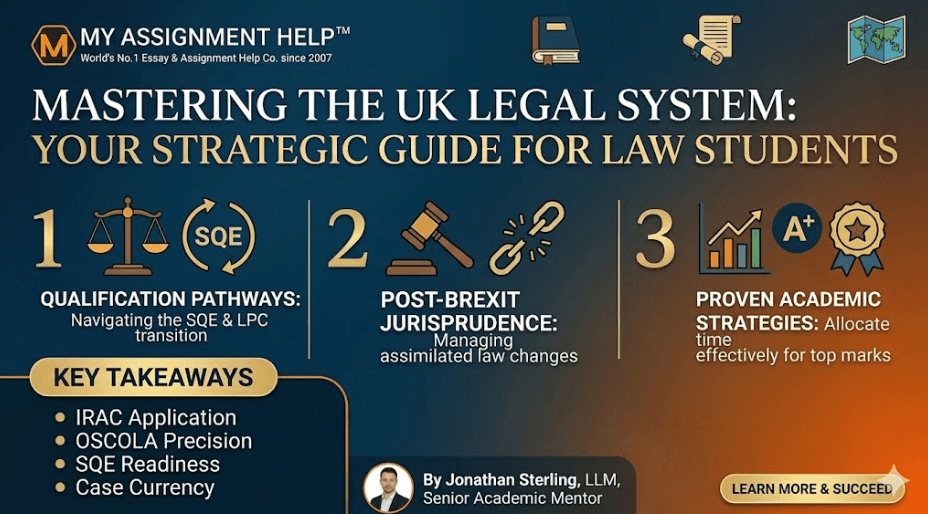
1. The Evolution of Qualification: SQE vs LPC Prep
For years, the Legal Practice Course (LPC) was the standard bridge to becoming a solicitor. However, as of 2026, the Solicitors Qualifying Examination (SQE) has fully matured as the primary assessment framework. Students often find themselves at a crossroads when determining their preparation strategy. While the LPC was heavily based on academic coursework, the SQE is a more rigorous, two-stage assessment focusing on Functioning Legal Knowledge (SQE1) and Practical Legal Skills (SQE2).
Because the SQE requires a deeper grasp of practical application, many candidates find that standard university notes are insufficient. Securing professional support specifically geared toward SQE-style multiple-choice questions (MCQs) and simulated legal office tasks can be the difference between a pass and a fail in this competitive landscape.
2. Post-Brexit Jurisprudence: The Impact on UK Case Law
In 2026, we are seeing the long-term effects of the Retained EU Law (Revocation and Reform) Act. The UK courts are now more frequently departing from “retained EU law” (now termed assimilated law), creating a shift in how precedents are handled in employment, environmental, and competition law.
For law students, this means that citing pre-2020 cases requires careful verification of their current status under the new UK-centric framework. This volatility makes academic writing particularly treacherous; utilizing specialized assistance ensures that your citations reflect the very latest judicial departures and legislative amendments.
3. Statistical Insights into Legal Education Performance
Success in UK law schools is increasingly tied to the ability to perform critical analysis rather than descriptive writing. Recent institutional data suggests that students who spend at least 35% of their preparation time on ‘Application’ (applying rules to facts) achieve significantly higher marks than those who focus predominantly on ‘Rule’ memorisation. For international students, the linguistic nuances of “Legalese” represent an additional hurdle, making professional support mechanisms vital for parity in performance.
Key Takeaways for Legal Excellence
- Embrace Criticality: UK markers prioritise your ability to critique the law over your ability to describe it.
- Master OSCOLA: Correct citation is the hallmark of a professional legal mind.
- Utilise IRAC: Use this structure to ensure your problem-question responses are logical and comprehensive.
- Monitor SQE Updates: Ensure your study plan aligns with the latest SRA assessment windows.
- Check Case Currency: Always verify if a case has been impacted by recent post-Brexit legislative reforms.
See also: Gaming Industry Innovations
Frequently Asked Questions (FAQ)
How do I choose between the SQE and the LPC?
While the LPC is being phased out, it may still be available for those who started their law journey before September 2021. Most current students must opt for the SQE.
Has Brexit made UK Law easier to study?
On the contrary, it has added a layer of complexity as students must now understand both the historical EU influence and the new, independent UK legal trajectory.
Why is the ‘Rule of Law’ so central to UK assignments?
The Rule of Law is a constitutional principle ensuring that everyone, including the government, is subject to the law. It is a foundational concept frequently tested in Public Law modules.
About the Author: Jonathan Sterling
Jonathan Sterling is a Senior Content Strategist and Academic Mentor at MyAssignmentHelp, based in Chancery Lane, London, WC2A. With an LLM in International Commercial Law from a top UK university and a decade of experience in academic consultancy, Jonathan specializes in helping students navigate the complexities of the British legal framework.