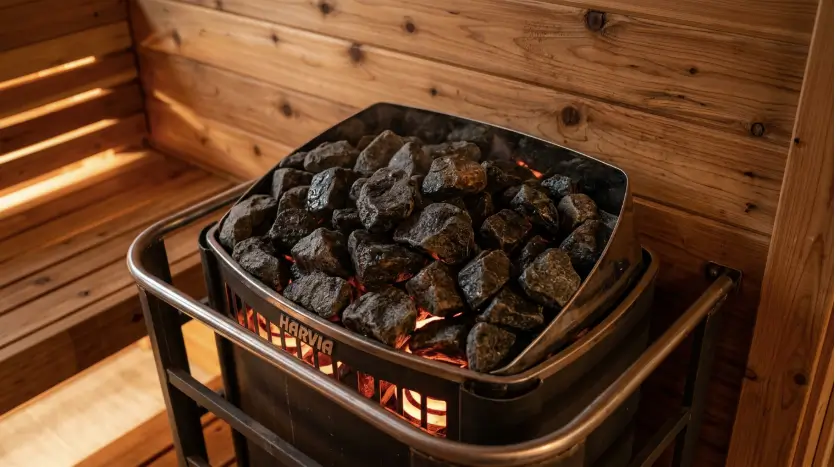

Cold outdoor temperatures add roughly 15 to 30 percent to a sauna heater’s preheat time compared to mild weather, which works out to about 1 to 2 extra kilowatt-hours per session, or 15 to 30 cents at typical residential electricity rates. The bigger cost driver over a winter is not the heater’s wattage but how well the cabin holds heat once it gets there, since a poorly insulated structure forces the heater to keep working through the entire session rather than cycling off once temperature is reached.
How Much Longer Does Preheat Take in Freezing Weather?
A cabin that reaches temperature in 30 minutes at 50 degrees outside might need 40 to 45 minutes when it is 10 degrees outside, since the heater is fighting a much larger temperature gap between the outdoor air and the target interior temperature, plus heat loss through the walls, door seal, and any glass. That extra 10 to 15 minutes of full-power run time is where most of the winter cost increase comes from, not from the heater running hotter or harder than it would in summer, just longer before it reaches the point where the thermostat starts cycling it on and off to maintain temperature.
What Does an Extra Winter Session Actually Cost in Electricity?
A 6 kW heater running at full draw for an extra 15 minutes of cold-weather preheat uses about 1.5 kWh beyond what the same session would use in mild weather. At a national average residential rate in the neighborhood of 15 to 17 cents per kWh, that is roughly 23 to 26 cents of additional cost per session, which adds up to a few dollars a month for someone using a sauna three or four times a week through winter. It is a real but modest increase, not the dominant line item in a household’s winter energy bill, and it is smaller than the savings available from fixing a poorly insulated cabin in the first place.
Does Cabin Insulation Matter More Than Heater Size in Winter?
Generally yes. A cabin built with a proper foil-faced vapor barrier behind the interior wood paneling and adequate wall insulation holds heat far better against freezing outdoor air than a thin-walled or poorly sealed structure, and that difference shows up directly in how long the heater runs per session. An undersized heater in a well-insulated small cabin often outperforms, on both comfort and cost, an oversized heater fighting heat loss through gaps around the door or an under-insulated ceiling. Before assuming a bigger heater is the fix for a cabin that struggles in winter, it is worth checking door seals and insulation, since that is frequently the cheaper and more effective correction.
Does an Undersized Heater Actually Cost More Over a Winter?
Yes, and this is a common miscalculation. An undersized heater does not just take longer to reach temperature, it often runs near full output for the entire session trying and failing to fully catch up, especially against cold outdoor air, which can use more total energy over a season than a correctly sized heater that reaches its target and then cycles on a thermostat. The standard sizing rule, about 1 kW per 45 to 50 cubic feet of all-wood interior with roughly 20 percent added for glass, is worth following closely in a cold climate specifically, since the margin for error shrinks when outdoor temperatures are working against the heater rather than being neutral.
How Does Wood Heat Compare for Winter Operating Cost?
A wood-burning sauna heater avoids an electric bill entirely, but it has its own cold-weather costs: more wood per session to overcome the larger heat loss, more time spent building and tending the fire before the room is usable, and storage space for enough dry, seasoned wood to get through a winter of regular use. Whether that ends up cheaper than electric heat depends heavily on local firewood prices and how much someone values the extra active time a wood fire requires compared to flipping on an electric heater’s thermostat and walking away. Neither option eliminates the cold-weather cost increase; it just shows up as dollars per kWh on one side and cords of wood on the other.
See also: The Doctor-Behind-the-Screen Test: I Ran Six Online Estradiol Providers Through Eight Questions
What Should a Beginner Check Before Buying for a Cold Climate?
Confirm the heater’s rated output against the cabin’s actual cubic footage using the standard kW-per-cubic-foot rule, and lean toward the higher end of the suggested range rather than the lower end if winters regularly drop below freezing. Check that the cabin’s insulation and vapor barrier are rated for the local climate rather than a generic three-season build, since that single factor affects winter running cost more than which heater brand gets chosen. It also helps to compare specs and included accessories across current models before committing. Working through the SweatDecks sauna heaters collection alongside a couple of other specialty retailers makes it easier to see how wattage, control type, and rock capacity line up against a specific cold-climate cabin size.
Does the Research Change Based on Climate?
The core cardiovascular research behind sauna use comes largely from Finland, a genuinely cold climate where indoor sauna bathing is a long-standing habit built around exactly this kind of weather, so the population data was gathered under conditions similar to a cold-winter setup rather than a mild one. A 2018 review in Mayo Clinic Proceedings and a 2001 paper in The American Journal of Medicine both summarize this research without suggesting outdoor climate changes the associated cardiovascular benefit, since the exposure being studied happens inside a heated room regardless of what the weather is doing outside. If anything, a cold climate makes the indoor session feel like a bigger contrast against the outdoor temperature, which is part of why sauna culture developed the way it did in a country with long, cold winters in the first place.
Frequently Asked Questions
How much more does it cost to run a sauna heater in winter? A well-insulated cabin sees roughly a 15 to 30 percent longer preheat in freezing weather, about 1 to 2 extra kWh per session, or 15 to 30 cents at typical electricity rates.
Does a bigger heater cost more to run in cold weather? A correctly sized heater usually costs less overall than an undersized one, which stays on longer trying to reach and hold temperature against outdoor cold.
Does insulation quality affect winter operating cost? Yes, significantly. Proper vapor barrier and wall insulation reduce how long and hard the heater has to run each session in freezing weather.
Is a wood-burning heater cheaper to run in winter than electric? Wood avoids an electric bill but has its own cold-weather cost in fuel and time, so the comparison depends on local wood prices.
References
- Cardiovascular and Other Health Benefits of Sauna Bathing: A Review of the Evidence, Mayo Clinic Proceedings, 2018
- Benefits and risks of sauna bathing, The American Journal of Medicine, 2001
- Effects of heat and cold on health, with special reference to Finnish sauna bathing, American Journal of Physiology, 2018
By Carla Bishop